
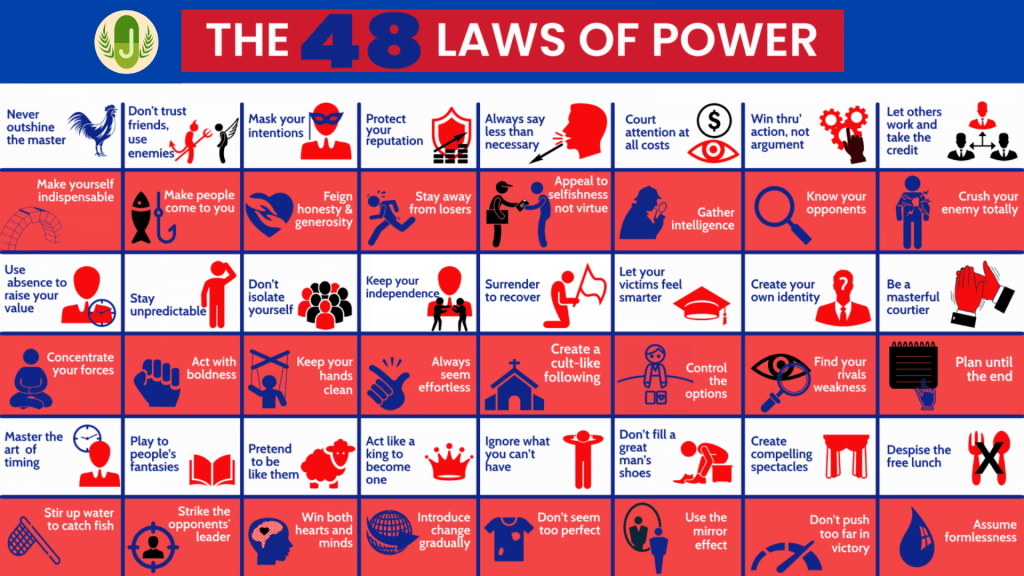
The 48 Laws of Power by Robert Greene is a guide to understanding power dynamics in social, political, and business interactions. The book distills historical and philosophical examples into 48 distinct laws, each describing a strategic approach to gaining, maintaining, or leveraging power. Greene combines lessons from historical figures like Napoleon Bonaparte, Machiavelli, and Sun Tzu to offer advice on navigating complex power structures and interpersonal relations.
While controversial due to its unapologetic approach to manipulation and control, Greene’s book has resonated with readers interested in power, strategy, and influence. Each law is presented with examples, stories, and illustrations to convey the principles in action.
Some of those laws that I have found extremely helpful in any situation :
Law 1: Never Outshine the Master
Greene advises that one should avoid outshining a superior as it may incite jealousy or insecurity. Instead, subtly reinforce the master’s ego and make them feel secure in their position to maintain favor and avoid undermining one’s own status.
- Key Idea: Avoid provoking resentment from superiors by subtly demonstrating loyalty and admiration. Empowering those above you can protect your own position.
Law 2: Never Put Too Much Trust in Friends, Learn How to Use Enemies
This law highlights the potential risks of relying too much on friends, who may betray due to envy or lack of loyalty. Greene suggests finding ways to use adversaries, as their fear or respect may make them more reliable.
- Key Idea: Friends may betray, while enemies can become valuable allies. Leverage relationships strategically based on reliability, not emotions.
Law 3: Conceal Your Intentions
Keeping one’s goals and plans private avoids giving others a chance to obstruct or counter them. By concealing true intentions, one can mislead others into lowering their guard or even helping to achieve their goals.
- Key Idea: Opacity in intentions protects plans and reduces external interference. Mystery can be a powerful asset.
Law 4: Always Say Less Than Necessary
By speaking sparingly and choosing words carefully, one can maintain a position of control, avoid saying something harmful, and project an aura of mystery or wisdom.
- Key Idea: Economize words for control, avoiding unnecessary disclosures. Speaking less adds to your perceived power and depth.
Law 5: So Much Depends on Reputation – Guard It with Your Life
Greene stresses the importance of a strong reputation, which enhances influence and garners respect. He advises defending it from attacks and upholding an image of competence and respectability.
- Key Idea: A solid reputation is a shield; protect it vigilantly. Consistent actions aligned with this image strengthen your influence.
Law 8: Make Other People Come to You – Use Bait if Necessary
By being the one sought out, one gains control over interactions. Greene suggests using allure or intrigue to make others approach, placing oneself in a position of power.
- Key Idea: Control encounters by becoming a focal point. Creating demand ensures influence over the terms of engagement.
Law 9: Win Through Your Actions, Never Through Argument
Greene asserts that actions are more persuasive than words, as they demonstrate rather than explain. He advises focusing on performance rather than debating.
- Key Idea: Actions carry weight beyond words. Demonstrate value tangibly rather than attempting to convince verbally.
Law 10: Infection: Avoid the Unhappy and Unlucky
This law advises avoiding those who bring misfortune or negativity, as these influences can be contagious and undermine one’s progress.
- Key Idea: Distance yourself from negative influences to protect your progress. Surrounding yourself with positive, successful people fosters growth.
Law 11: Learn to Keep People Dependent on You
By making oneself indispensable, one gains loyalty and protection from those who rely on them. Greene advocates cultivating a unique value that others cannot replace.
- Key Idea: Become irreplaceable by building unique expertise or resources, securing your position through dependence.
Law 12: Use Selective Honesty and Generosity to Disarm Your Victim
Occasional honesty and generosity can create trust and disarm others, making them more receptive to your influence.
- Key Idea: Selective transparency fosters trust. Strategic generosity can create goodwill, increasing influence.
Law 13: When Asking for Help, Appeal to People’s Self-Interest
When seeking assistance, align your request with the other person’s interests, so they feel personally motivated to help.
- Key Idea: Appeal to self-interest rather than expecting altruism. Connecting your needs to their goals enhances cooperation.
Law 14: Pose as a Friend, Work as a Spy
Greene advocates observing others closely to understand their intentions and preferences, which can be valuable information for gaining influence.
- Key Idea: Strategic observation uncovers useful insights. Gathering intelligence on others aids in understanding and influence.
Law 16: Use Absence to Increase Respect and Honor
By becoming scarce, one can increase others’ desire and appreciation. Avoiding overexposure maintains one’s allure and significance.
- Key Idea: Scarcity creates value. Controlled presence heightens your impact and preserves esteem.
Law 19: Know Who You’re Dealing With – Do Not Offend the Wrong Person
Greene emphasizes the importance of understanding the personalities, weaknesses, and strengths of others before engaging with them. Misjudging someone can lead to unintended and often damaging consequences.
- Key Idea: Recognize each person’s nature to avoid unnecessary conflict. Tailor your approach based on their temperament to protect your own position.
Law 21: Play a Sucker to Catch a Sucker – Seem Dumber Than Your Mark
Presenting oneself as less knowledgeable or skilled can make others lower their guard. Greene explains that feigned ignorance can be a powerful strategy for discovering people’s intentions.
- Key Idea: Underplaying your intelligence encourages others to reveal more. By appearing less capable, you often gain insights and the upper hand.
Law 22: Use the Surrender Tactic: Transform Weakness into Power
When outmatched, surrendering temporarily can provide an opportunity to regain strength and strike later. Greene argues that showing restraint in difficult situations can prevent losses and allow for strategic planning.
- Key Idea: Yield temporarily when necessary. Surrendering strategically buys time and can lead to a stronger comeback.
Law 23: Concentrate Your Forces
Rather than spreading resources too thin, Greene suggests focusing efforts on key strengths or areas of influence. Concentrated effort magnifies impact and prevents energy from being wasted on distractions.
- Key Idea: Focus energy on critical goals or projects. Concentrated effort enhances effectiveness and maximizes influence.
Law 24: Play the Perfect Courtier
The art of courtier behavior involves subtly flattering and supporting those in power, mastering politeness, and avoiding unnecessary conflict. Greene explains that adaptability in different social dynamics can make one indispensable.
- Key Idea: Diplomacy and tact ensure smooth relations. Courteous and adaptable behavior wins favor with influential people.
Law 25: Re-Create Yourself
Greene argues for the importance of shaping one’s own identity to align with desired goals or roles. By creating a compelling self-image, one can project authority and influence perception.
- Key Idea: Craft your own persona. Self-reinvention aligns your public image with your ambitions, enhancing control over how others view you.
Law 26: Keep Your Hands Clean
Maintaining a spotless image is essential. Greene advises against getting involved directly in questionable actions, instead suggesting delegation or distancing oneself from messy situations.
- Key Idea: Protect your reputation by avoiding visible controversy. Delegate any controversial actions to maintain a pristine image.
Law 27: Play on People’s Need to Believe to Create a Cult-like Following
Greene advises using belief and ideology to gain loyalty. By offering a compelling vision or values, leaders can inspire commitment and loyalty from others.
- Key Idea: Inspire devotion by aligning with values or beliefs. Creating a compelling narrative encourages loyalty and group cohesion.
Law 28: Enter Action with Boldness
Greene believes that bold moves attract attention and respect, while timid or hesitant actions are often overlooked. He suggests committing fully to one’s decisions and actions to gain authority.
- Key Idea: Boldness inspires respect and reduces opposition. Full commitment to decisions enhances credibility and attracts attention.
Law 29: Plan All the Way to the End
Planning meticulously ensures better preparation for obstacles. Greene advises visualizing outcomes and adjusting for potential challenges to maintain control throughout a process.
- Key Idea: Anticipate and prepare for the journey from start to finish. Detailed planning mitigates unforeseen challenges.
Law 30: Make Your Accomplishments Seem Effortless
Presenting one’s achievements as natural or easy conceals the hard work and skill behind them, making them appear more impressive. Greene advises mastering this to elevate others’ perception.
- Key Idea: Display results without revealing the effort. Perceived ease enhances the allure of your success.
Law 32: Play to People’s Fantasies
People often gravitate toward idealistic visions over harsh truths. Greene suggests using imagination to inspire others by appealing to their dreams and aspirations.
- Key Idea: Tap into hopes and aspirations. Fantasies provide an escape from reality, making influence more appealing.
Law 35: Master the Art of Timing
Greene explains the importance of recognizing when to act and when to wait. Timing can be the difference between success and failure, making patience a powerful strategic tool.
- Key Idea: Recognize the importance of patience and timing. Waiting for the right moment can amplify effectiveness.
Law 37: Create Compelling Spectacles
Spectacle can capture attention and make ideas memorable. Greene advises using visually striking or dramatic methods to make a lasting impact.
- Key Idea: Use drama to create memorable impressions. Compelling visuals engage and reinforce messages.
Law 38: Think as You Like but Behave Like Others
This law emphasizes the importance of blending in outwardly while maintaining independent thought. Greene believes subtle conformity prevents unnecessary resistance.
- Key Idea: Adapt outward behavior to fit social norms. Conform outwardly to prevent opposition while maintaining private autonomy.
Law 39: Stir Up Waters to Catch Fish
Creating controlled chaos can force others to make rash decisions. Greene advocates for strategic disruption to gain a psychological edge over competitors.
- Key Idea: Use disruption to unbalance opponents. Keeping others unsettled encourages mistakes.
Law 41: Avoid Stepping into a Great Man’s Shoes
Creating one’s unique path is essential, as filling another’s role invites comparison. Greene advises finding a unique voice and approach to avoid being overshadowed.
- Key Idea: Forge your own identity. A distinct approach avoids constant comparison.
Law 42: Strike the Shepherd and the Sheep Will Scatter
Addressing the leader of a problematic group disrupts the entire group. Greene suggests eliminating or neutralizing influential figures to reduce opposition.
- Key Idea: Target the root of problems. Removing key players can destabilize opposition.
Law 43: Work on the Hearts and Minds of Others
Greene emphasizes winning others’ loyalty and affection, rather than relying solely on force or control.
- Key Idea: Cultivate loyalty through empathy. Winning trust creates a stronger influence.
Law 44: Disarm and Infuriate with the Mirror Effect
Mirroring others’ actions can confuse or agitate them. Greene uses this method to destabilize opponents.
- Key Idea: Reflect behavior to throw others off balance. Mimicry can unsettle or reveal.
Law 45: Preach the Need for Change, But Never Reform Too Much at Once
Greene advises incremental changes to avoid overwhelming others. Sudden shifts provoke resistance, while gradual adaptation eases transition.
- Key Idea: Change gradually to ease acceptance. Incremental reforms reduce opposition.
Law 46: Never Appear Too Perfect
Perfection attracts envy. Greene advises displaying some faults to appear more approachable and human, reducing envy or resentment.
- Key Idea: Show vulnerability to avoid envy. Displaying minor flaws diffuses resentment.
Law 47: Do Not Go Past the Mark You Aimed For; In Victory, Learn When to Stop
Excessive ambition can lead to downfall. Greene suggests knowing when to stop after achieving success, as overextension can invite failure.
- Key Idea: Recognize when to withdraw after success. Overextending invites unnecessary risks.
Law 48: Assume Formlessness
Adaptability is crucial in the ever-changing landscape of power. Greene encourages constant reinvention and flexibility to avoid predictability.
- Key Idea: Embrace change and remain flexible. Adaptability ensures survival and continued influence.
The 48 Laws of Power presents a pragmatic, and at times controversial, framework for navigating power dynamics. Greene’s laws distill complex strategies into actionable steps for gaining influence, whether in personal or professional contexts. While Greene advocates calculated behavior, each law offers insights into how to manage relationships, make strategic decisions, and cultivate influence effectively. This, based on my own reading, is what i took the most and used in everyday life. The other laws somewhat explain these key area and elaborate on them further. If you wish to gain the full knowledge, please purchase the book 48 Laws of Power, you will not regret it.

Leave a comment